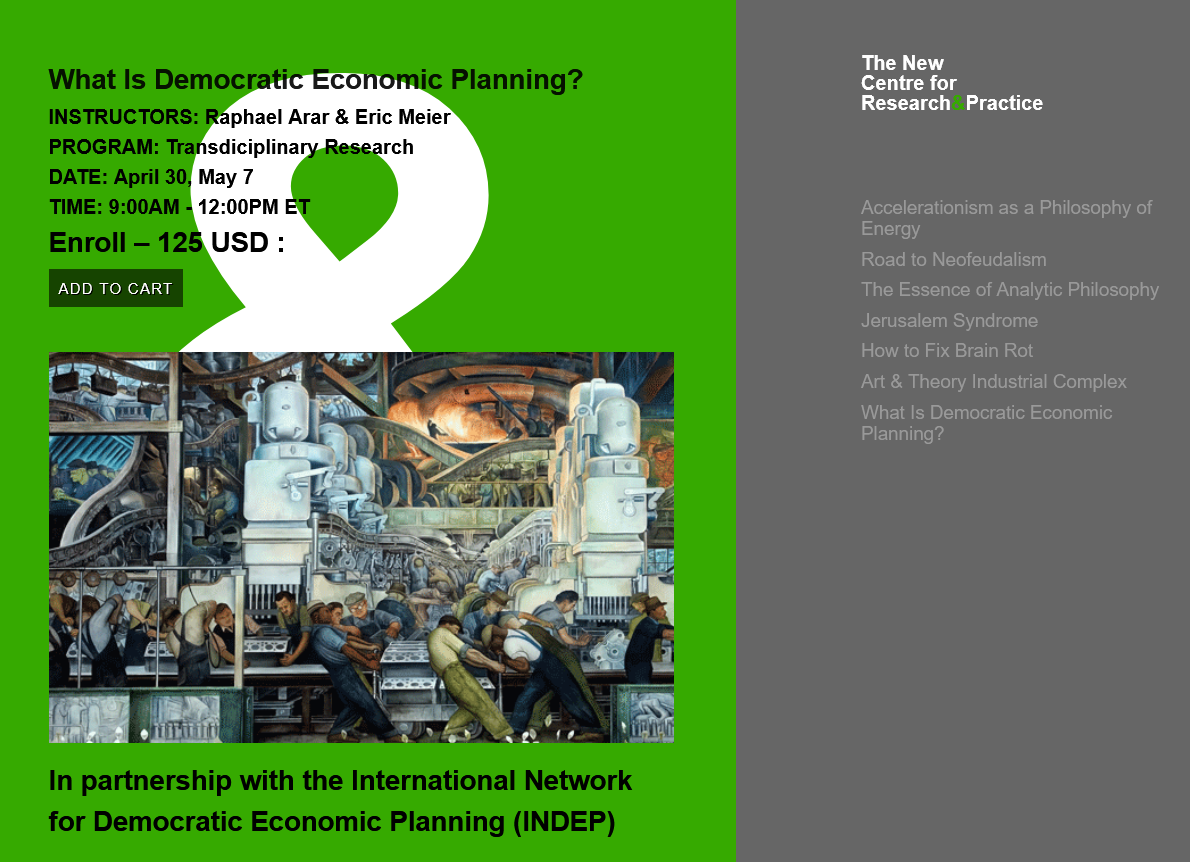
The New Centre for Research and Practice is partnering with INDEP for an introductory online workshop on Democratic Economic Planning. The workshop titled ‘What is Democratic Economic Planning?’ will be held by Raphael Arar and Eric Meier and will take place in two online sessions of about 3 hours on April 30 and May 7 this year. It will will be held in English and will cost 125USD. You can enroll for the workshop here.
The New Centre for Research and Practice is also offering scholarships for their certificate program, more information on that can be found here. The deadline for applications is February 17.
Description:
This Roundtable explores Democratic Economic Planning (DEP) as an alternative to the financialized market-based economy. With neoliberalism in crisis and authoritarian movements on the rise, there’s renewed interest in how economies might be organized differently.
Any proposal for economic planning has to answer several basic questions: How do you gather accurate information about what people need and what resources exist? What do you measure things in—money, labor time, physical units, some combination? Who makes decisions, and how centralized should that be? Do markets have any role, and if so, what kind? How do you motivate work and handle distribution?
These questions are not new. They emerged in the Socialist Calculation Debate of the 1920s-30s. Answers have been attempted differently across historical experiments—from Soviet central planning to Chile’s Cybersyn project to contemporary participatory budgeting initiatives. Today’s proposals range from participatory economics to algorithmic coordination models that imagine repurposing Amazon’s logistics infrastructure for democratic ends.
SESSION ONE: The opening session will lay out this intellectual landscape and the core problems any planning model confronts. We’ll look at how these questions connect to contemporary concerns about technology, ecology, and democratic transition strategies.
SESSION TWO: The second session builds from student research to map current debates and identify where productive collective work might happen.
OUTCOMES: You’ll understand the fundamental challenges facing economic planning proposals and how different models tackle them. We’ll cover key historical debates and experiments alongside contemporary paradigms that leverage digital infrastructure. You’ll gain frameworks for evaluating whether planning proposals are actually democratic and practically viable, plus exposure to real-world implementations and transition strategies. And you’ll connect with others exploring alternatives to market coordination.