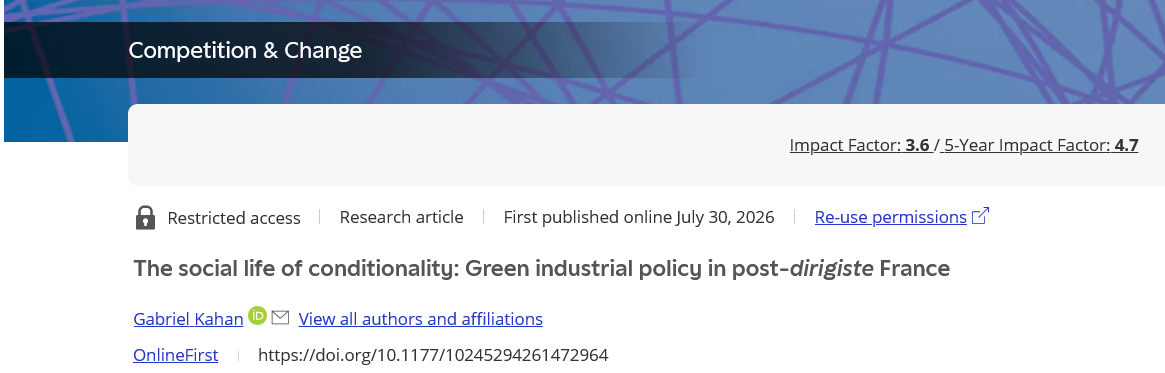
This paper by Gabriel Kahan was recently published in the academic journal Competition & Change. It examines how the state tries to influence private capital’s decarbonisation through green investment subsidies. To explore this, the paper examines two green subsidies in France, both aimed at decarbonising some of the country’s highest-emitting industrial sites.
By attaching conditions to public incentives, the state can steer economic development towards a more sustainable economy. However, the existence of strong conditions does not always translate into effective action. The article shows that, while the French subsidies include strong conditionalities, their “soft” enforcement can enable preferential treatment for certain companies.
The article provides a useful starting point for understanding the scope of these policies and their capacity to discipline private capital. It also highlights the contradictions of such policies in post-dirigiste France, as well as the importance of looking beyond the formal design of industrial policies and examining how they are implemented in practice. This makes the article particularly relevant to discussions about the role of the state in directing economic activity and the challenges involved in pursuing a green industrial policy.
You can read the full paper here.
You can read the abstract here:
The advent of state-led decarbonization has brought with it a renaissance of industrial policy. To evaluate how such policies discipline private capital, social scientists are turning to the conditionalities embedded in public-private contracts. Yet many continue to fetishize the terms of contractual agreements at the risk of ignoring how these terms are, in actuality, enforced. This paper theorizes the “social life” of conditionality through a framework that combines contractual design with the administrative practices that determine the process of enforcement. To illustrate, I apply this framework to two green investment subsidies in France—both designed to decarbonize the 50 highest emitting industrial sites as part of the country’s turn toward “ecological planning.” Drawing on public records and interviews, the case study indicates conditionalities are in fact strong, yet the state is pursuing a form of “soft” enforcement that enables preferential treatment of firms. In doing so, the paper illustrates the contradictory character of green industrial policy in post-dirigiste France. Moreover, it demonstrates the urgency of placing greater attention on the immediate institutional environments in which industrial policies play out. Once this environment is mapped, scholars will find they are better equipped to investigate the broader power struggles that shape such policies.