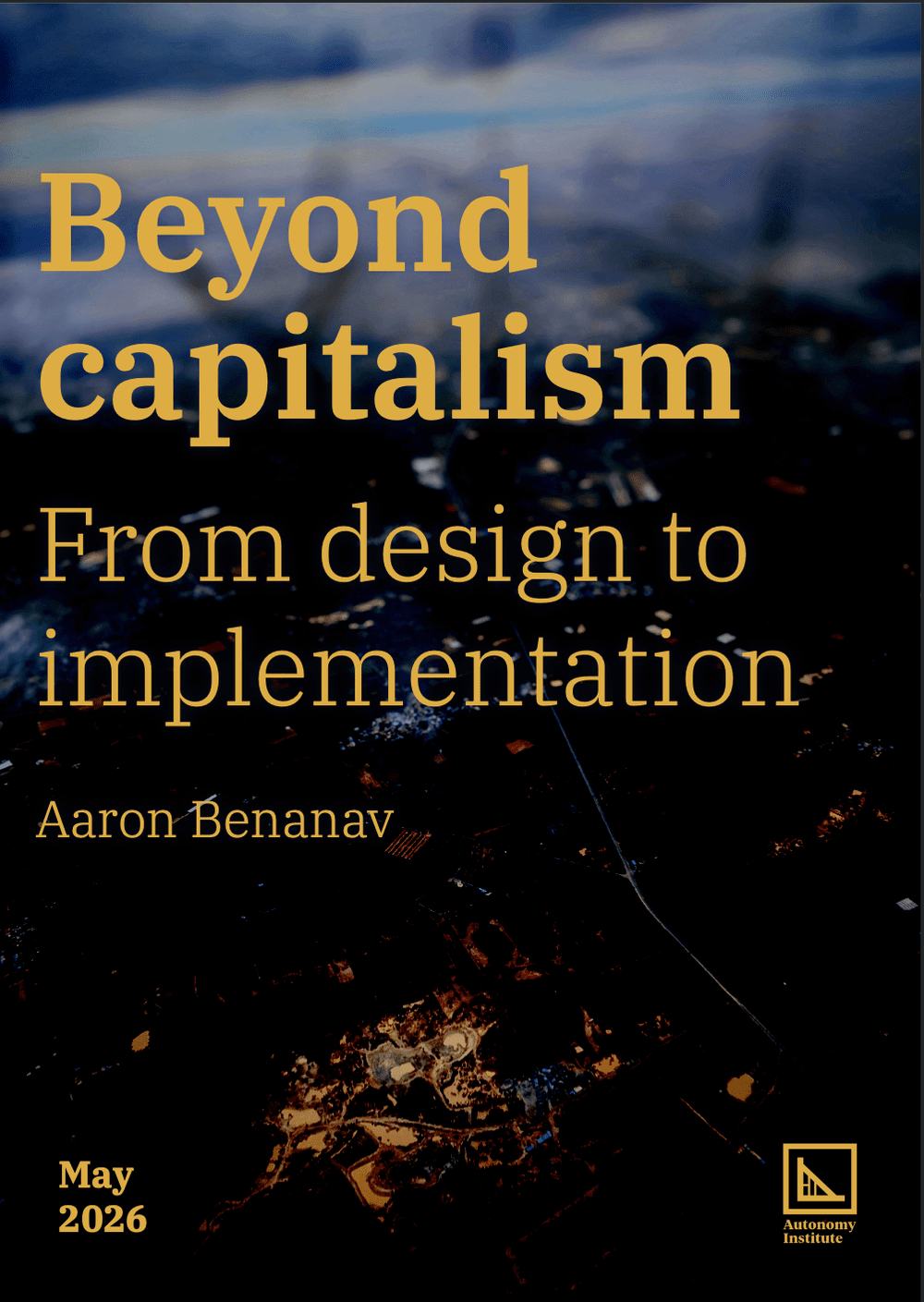
The think-tank Autonomy has published a report by Aaron Benanav where he proposes a transition strategy that will result in the replacement of capitalism with multi-criterial socialism.
A summary of the report can be found below:
What would it take to organise an economy not around financial returns on capital invested, but rather the plurality of aims and ends people actually care about?
Ecological sustainability, material security, meaningful work, democratic participation, the quality of collective life: these are the things most people value, and no serious political movement can avoid invoking them. Yet in the institutions that actually govern production and investment, these goals appear only as secondary considerations – constraints on an underlying focus on economic efficiency, on minimising costs and maximising revenues.
In the first two instalments of this series, published across two issues of the New Left Review, Aaron Benanav argued that we can go beyond capitalism – restructuring the economy so that production is organised around multiple ends pursued for their own sake and governed by democratic institutions designed to navigate the trade-offs among those ends.
In these first two essays, Benanav’s core institutional move is the creation of two distinct digital currencies – credits for consumption, points for production – that sever the link between economic activity and private wealth accumulation. Investment is relocated from financial markets to democratically elected sectoral boards, whose returns are measured not in money but in cleaner energy, better care, more material security, and shorter working hours. A dense ecology of technical and civic associations sustains democratic life. None of this, he argues, requires the abolition of markets. What it requires is a change in the rules that govern activity within them – above all, through a change in money itself.
But even the most compelling institutional design is worth little if it cannot be built. Critics who might reject Benanav’s premise will argue against it on theoretical grounds. The more serious challenge comes from those who accept the vision in principle and ask: how do you actually get there from here? How do you move from an economy governed by profit to one governed by multiple and conflicting values without collapsing the economy in the process?
In this document, Benanav looks to answer these questions. The transformations he describes are often radical in scope – they decisively shift the mechanisms governing economic life – but, he suggests, they do not require that everything about the economy change at once. Instead, the transition proceeds through a sequence of major institutional reforms, each of which alters the balance of power and opens space for what comes next – replacing capitalism, piece by piece, with a truly multidimensional economy.
You can read the report here, while you can read the two essays by Benanav where he develops his proposal for a multi-criterial socialism here and here.