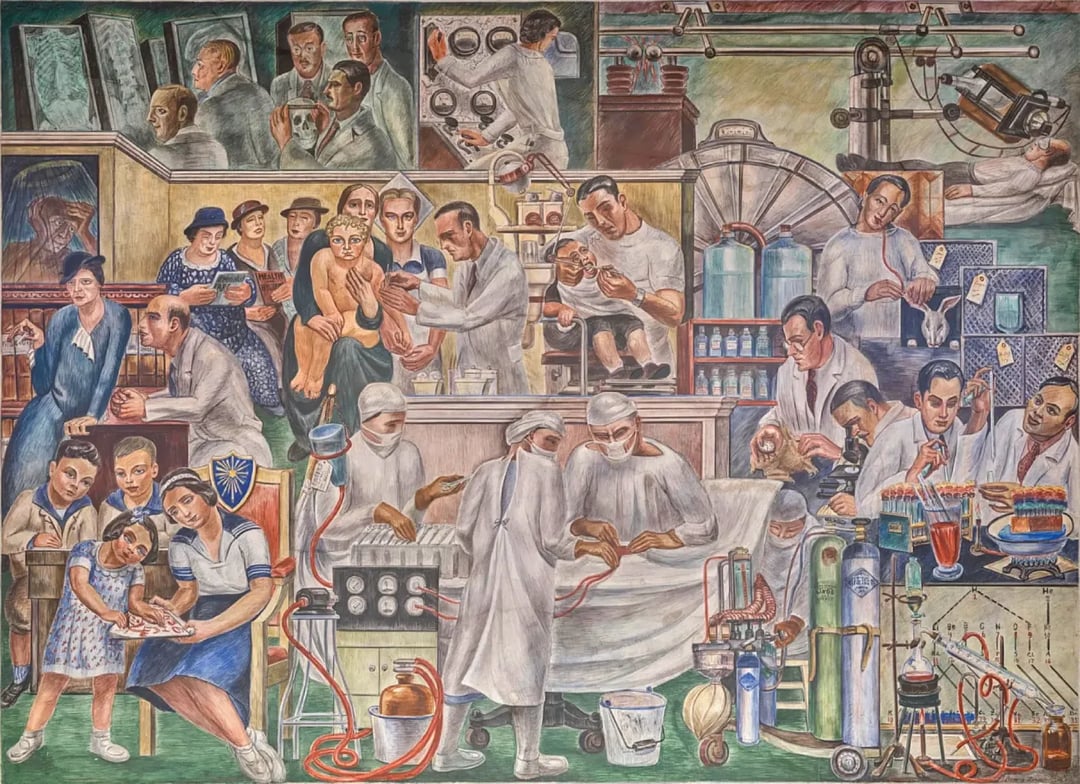
In an article for Geese Magazine, Nabi Eullmann critiques how science is organized under capitalism and envisions how it could be organized under communism through an critical exploration of the Group of International Communists’ (GIK) book Fundamental Principles of Communist Production and Distribution.
A summary of the article can be found below:
The desolate landscape of the academy is littered with yearning for fulfillment, stability, recognition, and the opportunity to meaningfully contribute. I have encountered many of the archetypes. The graduate student trapped in the petty bourgeois fiefdom of their supervisor (pompously termed principal investigator, or PI); the postdoc traversing the job market for the umpteenth time, with too much of their time, effort and identity tethered to science to walk away; the liberally-minded scientific ideologues who see bad politicians getting in the way of good people doing good life changing science; the tenured PI who has convinced themselves of the notion of meritocracy; those wracked with self-doubt; those nurtured into undiminished self-assurance.
For those outside the academy, disdain for the established, and schadenfreude for the drifters, are popular and understandable reactions to such triumphs and woes. After all, “fulfillment, stability, recognition, and the opportunity to meaningfully contribute” are luxuries rarely afforded to the vast majority of downwardly mobile working class folks. Why should the academy be any exception? The communist and the utopian might respond that these expectations must not be limited to some professional strata of scientists and the like, but should be reasonable and foundational for proletarians everywhere, regardless of intra-class location or geography.
As a working early-career scientist who finds meaning in his work, though has little hope of a stable career within science, how science is currently organized – and how it might be organized in a post-capitalist world – are questions that I have found generative. This is not only the case for a limited inquiry into my own field, but for utilizing the question of scientific production as a theoretical testing space for how to coordinate large-scale projects in the absence of alienation and private property.
Central to this inquiry is the demystification of science in terms of the technical and social composition of scientific production. To democratize science in a truly revolutionary manner is to engage all of society in this fundamentally social process. In short, what might a republican conception of science look like? By republican, I refer to the Marxian dual sense of the term: each person having the right to engage in the decision making process of scientific production (i.e. one’s political freedom), and each having access to the educational apparatus to choose to engage in that scientific production itself (i.e. one’s social freedom).
Today we are a world away from such a vision. Most workers are shut out of the scientific process at every level, including how it is funded, the day-to-day nature of the work, and how scientific consensus is formed. The responsibility for such production rests with those who have undertaken years of formal training, creating a dichotomy between intellectual and manual labor that is at once both superficial and prescriptive. I want to explore how else we might organize scientific production to truly socialize this most social of processes, and argue why the form of utopianism posited here is rooted in the concrete conditions that exist today. Conversely, hearkening back to a time of better science funding and demanding a slew of technocratic fixes that – as Levins and Lewontin put it in the opening quote of this essay – seek to recreate precisely those past conditions, is an escape fantasy that has no grounding in the current moment.
You can read the article here.