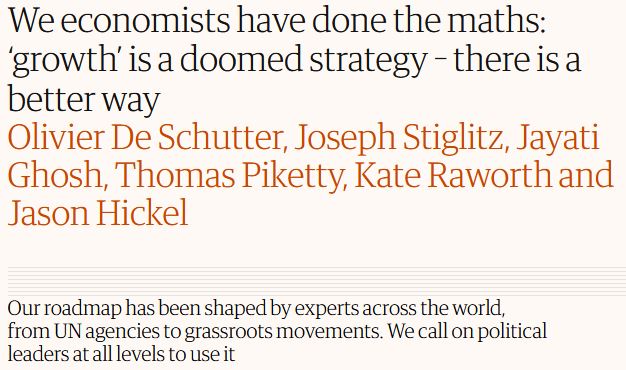
In a letter to the Guardian, Olivier De Schutter, chair of New Economies for Eradicating Poverty, Joseph Stiglitz, a Nobel laureate in economics, Jayati Ghosh, professor of economics at University of Massachusetts Amherst, Thomas Piketty, professor of economics at the Paris School of Economics, Kate Raworth, economist at Oxford University’s Environmental Change Institute and Jason Hickel, a political economist and professor at the Autonomous University of Barcelona argue that the current form of global capitalism is the root cause of global poverty and ecological crisis, that the proposals outlined in the Roadmap For Eradicating Poverty Beyond Growth will address both issues and that governments around the world should implement this roadmap.
One of the pillars of this roadmap is that poverty will be eradicated and an economic transition to a sustainable post-growth society will be implemented through democratic planning.
You can find excerpts from the open letter below:
We live in an age of manufactured scarcity. In a world richer than ever before, roughly one 10th of the world’s population still lives in extreme destitution. Millions of people cannot afford enough food, proper housing or basic healthcare, while a tiny minority accumulates unprecedented wealth and power. At the same time, droughts, megafires, floods and heatwaves remind us that our economies are pushing the planet beyond its limits….
That is why we have come together to develop and support the “roadmap for eradicating poverty beyond growth”. The roadmap provides a range of alternatives on how to move beyond the narrow “grow-tax-transfer” approach that has shaped policy for decades. It is not a blueprint shaped by a handful of experts. It is the exact opposite: over 18 months, more than 400 people – UN agencies, national governments, academic experts, civil society organisations, trade unions, social and solidarity economy actors and grassroots movements, from the global north and south – worked to answer a simple question: how can we end poverty and reduce inequalities without treating GDP growth as the primary condition for progress? More than 350 signatories have put their names to the plan, including Jean Drèze, Pavlina Tcherneva, Tim Jackson, Bhumika Muchhala, Julia Steinberger, Ndongo Samba Sylla, Timothée Parrique.We do not agree on every policy detail. But we are united in the conviction that our economies must be redesigned around the fulfilment of rights and collective wellbeing within planetary boundaries, rather than maximising output at any cost. Human rights here are not an afterthought; they are the organising principle for how we measure progress, set priorities and resolve trade‑offs. Social protection and public services are essential, but they cannot indefinitely compensate for economies that by design generate poverty wages, insecure jobs and unaffordable housing…..
Poverty is manufactured. That is the bad news – and the good news. What has been manufactured can be dismantled and replaced. We are putting concrete options on the table, all backed by detailed policy profiles that spell out evidence, implementation steps and real‑world examples. We call on political leaders at all levels to use them, to listen to those most affected, and to treat the end of poverty, the reduction of inequalities and the effective realisation of human rights as the measure by which economic policy should be judged.
You can read the open letter here, while you can read the Roadmap For Eradicating Poverty Beyond Growth here. If you agree with the roadmap, you can sign your name in support of the roadmap here.