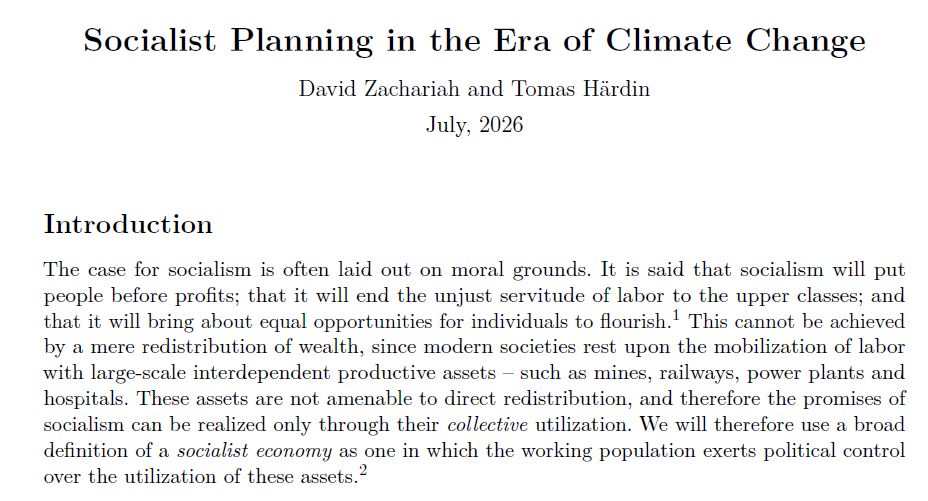
Tomas Härdin and David Zachariah have published a paper proposing a form for socialist planning that has been specifically designed to respond to the social, economic, political and ecological issues that have been created by capitalist-caused climate change.
A summary of the paper can be found below:
The case for socialism is often laid out on moral grounds. It is said that socialism will put people before profits; that it will end the unjust servitude of labor to the upper classes; and that it will bring about equal opportunities for individuals to flourish.1 This cannot be achieved by a mere redistribution of wealth, since modern societies rest upon the mobilization of labor with large-scale interdependent productive assets – such as mines, railways, power plants and hospitals. These assets are not amenable to direct redistribution, and therefore the promises of socialism can be realized only through their collective utilization. We will therefore use a broad definition of a socialist economy as one in which the working population exerts political control over the utilization of these assets.2
Yet, the desirability of socialism is not sufficient to render it feasible. A socialist economy cannot simply be wished into existence. Its economic feasibility rests on the possibility of building it out of elements from the existing capitalist environment within the lifespan of a given population. At the same time, the political feasibility of socialism requires it to address problems impeding the material well-being for a vast majority. We cannot expect to build mass movements with members committed to undertaking the risks of economic transformation, or defending its outcome, unless socialism can demonstrate successive gains over capitalism.3 We take these economic and political requirements to be the elementary feasibility conditions of socialism. They relegate all designs predicated on unconstrained abundance or widespread altruistic behaviors to the realm of science fiction and utopian speculation. Such designs lack strategic relevance for socialist movements aiming to build institutions that operate in a world constrained by material incentives, divisions of labor, and territorially bounded nation states.
In the advanced countries of the 1930s, a feasible socialism had to offer full employment and modernizing investments amidst capitalist stagnation and mass unemployment. In the 1960s, by contrast, it had to offer gains beyond the concessions won by organized labor under state-led, full employment growth paths. In the 2030s, the tightening of resource constraints through climate
changes, geopolitical conflict and demographic decline places new requirements on what socialism must plausibly deliver. Current projections estimate that the effects of climate changes alone will depress average real incomes across most of the world over the coming twenty-five years due to declining labor and agricultural productivity as well as rising costs of environmental damages.4 Worse still, the livelihoods and essential needs of the masses are put at stake as the severity of heat waves, forest fires and floods continually increases. The problems of adapting to and mitigating these conditions alter the coordinates of socialist politics. Relative to a deteriorating capitalist environment, a feasible socialist economy must possess the capacity to secure a range of resources required for the well-being of its population, while limiting the quantities of extracted critical resources and emitted waste products.
You can read the paper here.