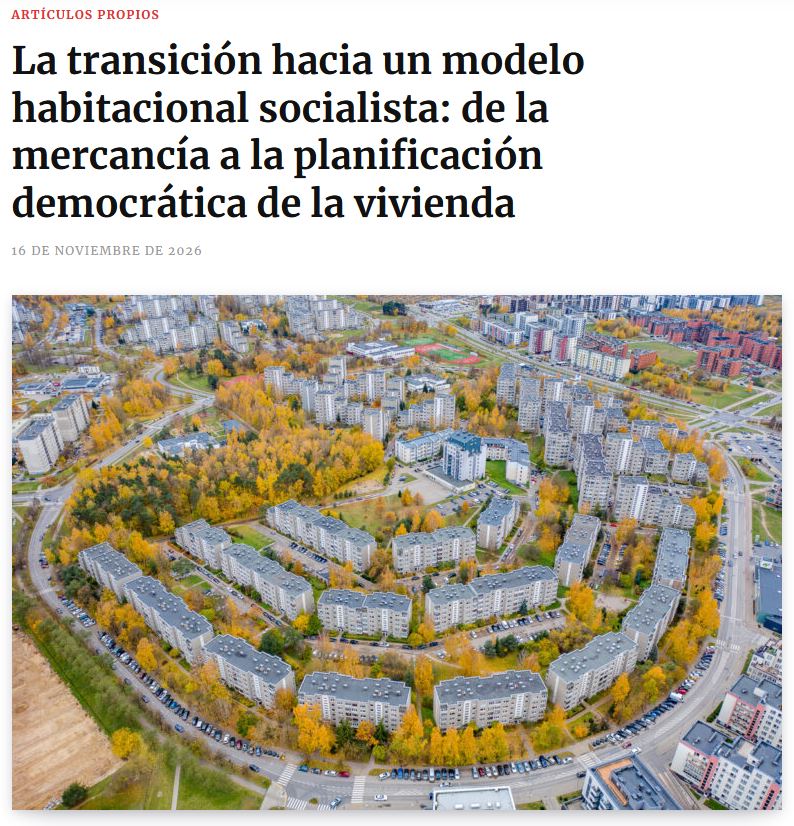
Our partner organisation Cibcom has published an article by Aingeru Ruiz that uses a critical evaluation of the provisioning of housing under capitalism, the Soviet Union, Cuba, Yugoslavia and East Germany to envision how the democratic economic planning of housing could occur in a communist society.
The introduction to the article can be read below:
For a few years now, a curious phenomenon expressed especially in social networks is causing debate in German public opinion: the DDR Museum in Berlin, originally designed to immersively expose a gray, monotonous and suffocating image of defunct East Germany, is causing exactly the opposite effect on its younger visitors.
The museum was designed for the public to open the closets of a narrow kitchen of the 70’s and feel relief from living in the vibrant capitalist West. However, when the young people of twenty-somethings examine the replicas of the monthly receipts of the austere prefabricated blocks (Plattenbau), they go into shock. They discover that an East German worker spent only between 3% and 5% of his salary to cover the rent, heating and hot water of his home. All this was guaranteed for life.
Irony is inevitable. Upon leaving the exhibition, those same young people return to a contemporary Berlin suffocated by gentrification, where investment macro-funds hoard tens of thousands of homes and where paying a simple room usually consumes more than half of their income. Suddenly, the “crawl” of the Soviet concrete block ceases to resemble an authoritarian dystopia and becomes an unattainable material paradise.
This youthful fascination is not simply Ostalgie (the famous nostalgia for East Germany), it is the symptom of a systemic fracture. The new generations are discovering that the right to a roof is essential and that the free market, with all its technology and promises, has been unable to provide it.
You can read the article (in Spanish) here.