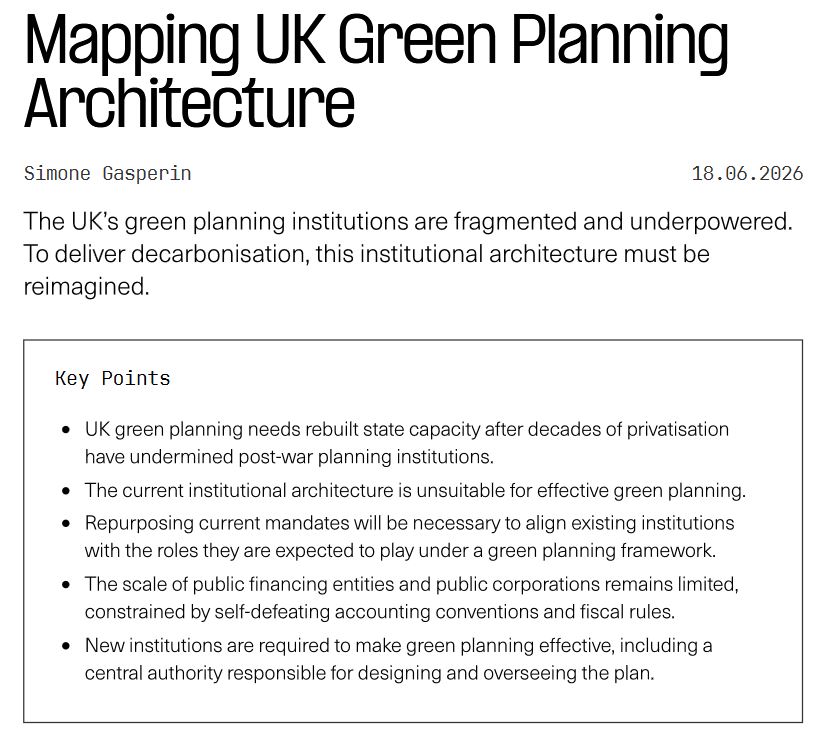
The think-tank Common Wealth has published a report by Simone Gasperin that maps out the existing green planning institutions in Britain, outlines their issues and proposes new green planning institutions that would design and oversee the decarbonisation of Britain.
You can read the report’s summary below:
Green planning is emerging as the progressive policy paradigm for decarbonisation. In the UK, the current Labour government’s ambitious clean power agenda and Industrial Strategy testify to a decisive shift away from the free-market fundamentalism that has long dominated the political spectrum, especially after Thatcher came to power in 1979.
But green planning must also become effective in delivering on its promise. Putting this paradigm into practice depends on the state’s capacity to deliver public investment at scale, provide key goods and services and coordinate various actors. A capacity that decades of privatisation and market-oriented reforms have drastically eroded.
Rebuilding a functional institutional architecture is a precondition for any future green planning to succeed. It requires, as a first step, a clear understanding of the entities currently in place, including their respective responsibilities and interactions.
This study offers a pioneering insight into the existing UK institutional architecture for potential green planning. It does so by mapping and assessing central-government public institutions across four policy fields: international, macro-financial, cross-cutting and sectoral.
The preliminary results are mixed, showing some potential but also significant shortcomings that should be addressed with the repurposing of existing institutions and, where necessary, the creation of new ones.
Existing institutions often have unsuitable mandates and confused governance
International and macro-financial institutions, in particular, hold mandates that are ill-matched to the roles required under a green planning framework. Cross-cutting and sectoral institutions, meanwhile, often combine inconsistent legal statuses with unclear relations and responsibilities — both among themselves and with their supervising departments.
The institutional architecture for green planning is partially incomplete
No blueprints without spades. The long list of advisory and regulatory bodies is no substitute for executive entities capable of directly undertaking public investment programmes and providing essential goods and services. The UK lacks public corporations with a direct capacity to deliver on the green plan’s sectoral decarbonisation objectives. Those that do exist, often lack the adequate scale and mandate.
Publicly owned commercial institutions are constrained by dysfunctional accounting rules
The main UK public financing institutions (UKEF, NWF, BII, BBB, NHB) and non-financial corporations (GB Energy, GBR and others) cannot achieve the systemic scale needed to support green planning objectives unless they are separated from the government’s accounts and granted autonomous borrowing powers — as it is already in most other European countries.
Green planning is at odds with the current fragmentation of sectoral interests and administrative levels affecting public institutions
Central government public institutions pursue their mandates independently and often replicate institutions from devolved nations and local authorities. Beyond drafting the plan itself — as a bottom-up exercise synthesising inputs from the main stakeholders — a newly established central planning institution should be responsible for the governance and supervision of the green planning process.
You can read the report here.