
Conference: Age of Planning?
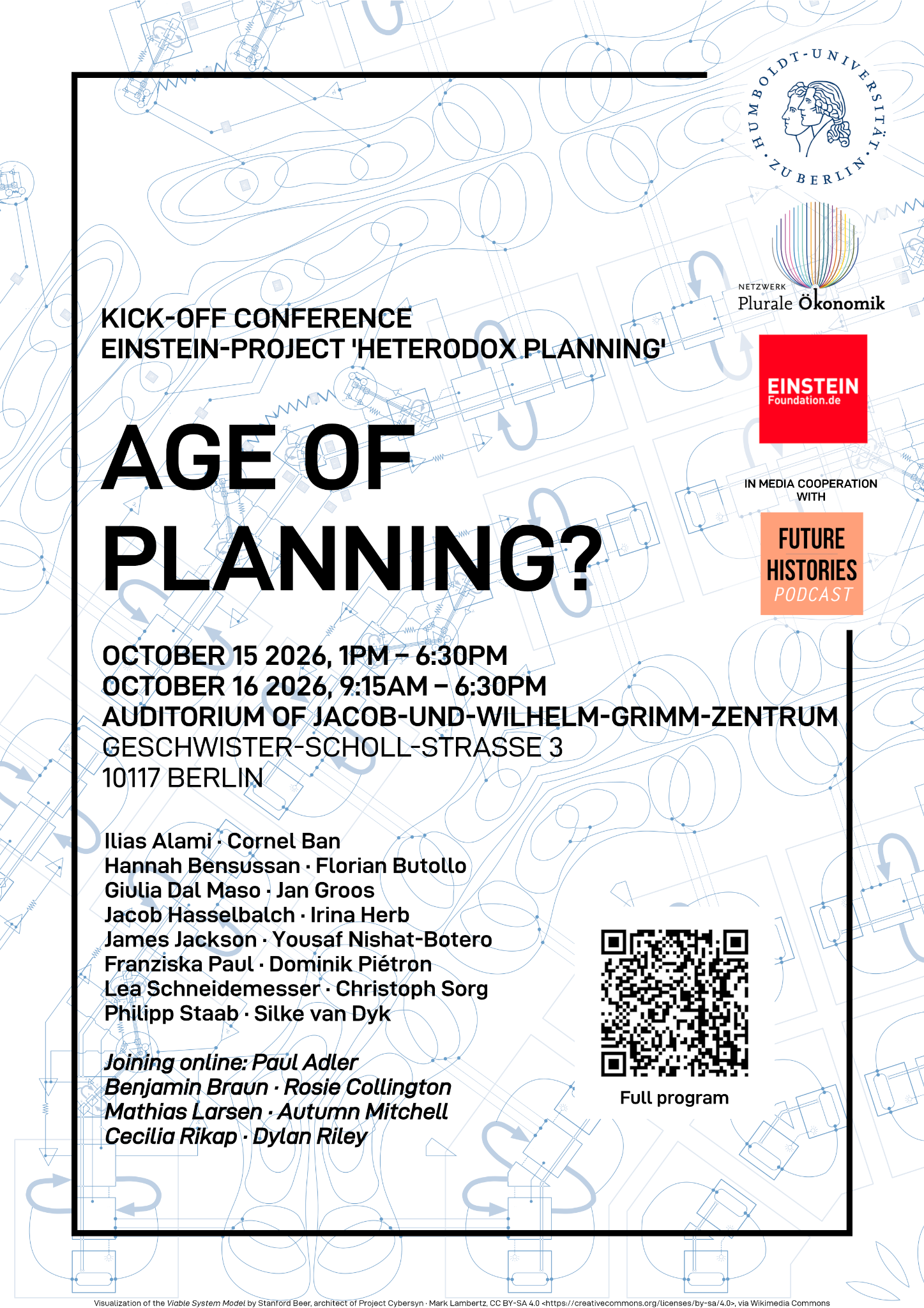
This event will take place in English.
The description and program have been taken from the event website.
To participate, please register here.
Description
In the wake of the Global Financial Crisis, the Covid-19 pandemic and the accelerating climate crisis, the failure of markets to address urgent collective problems has pushed the question of economic planning back onto the academic and political agenda. While much of the debate remains focused on models of post-capitalist planning, the “Age of Planning?” returns to the departure point of the new planning debate, that is, the observation that planning is already endemic in capitalism. Empirical work that engages with the concept of planning remains fragmented across three largely separate literatures: one tracing how corporations increasingly coordinate production, supply chains and investment outside of price signals (“corporate planning”); one tracing how states are returning to industrial policy, state ownership and green economic planning amid a new wave of state capitalism (“state planning”); and one tracing how the conscious decisions of central banks and institutional investors increasingly divorce investment decisions and funds available for them from previous market competition (“financial planning”).
“Age of Planning” brings these three strands into direct conversation for the first time. The guiding questions:
- How do we define planning in our different fields?
- Is planning making a comeback across such different fields and if yes why? How can we measure an increase or decrease of planning?
- What connects corporate, state and financial planning conceptually and empirically?
- How can we theorize these transformations in a way that also speaks to a normatively grounded, democratic perspective on planning?
Format
The conference opens on the morning of 15 October with “Rethinking Macroeconomic Planning in Europe” (MacroHub), a public policy workshop organised by the Netzwerk Plurale Ökonomik in cooperation with the research project “Heterodox Planning” (Humboldt-Universität zu Berlin / Einstein Foundation). From 9:00–12:00, it will be discussed how strategic public coordination can help navigate Europe’s fiscal rules and steer the green transition. Registration and further information.
The academic conference continues through the afternoon of 15 October and all of 16 October, with panels on financial planning, digital platforms, supply chain planning, decarbonization, social reproduction, municipal planning, state planning capacity and legitimacy, and the broader politicization of the economy.
The conference will be hybrid, combining in-person presentations with online presentations.
The Future Histories Lab will be media partner of the conference and record a live episode during the conference.
Background
The conference is the kick-off event for the research project “Heterodox Planning“, and builds on a growing body of work arguing that planning is not the antithesis of capitalist market economies but an endogenous feature of them. Firms plan production and investment ex ante within their own boundaries, states plan indirectly via markets to secure accumulation and legitimacy, and finance increasingly mediates between the two by allocating credit on the basis of anticipated rather than realised profitability. Bringing corporate, state and financial planning into a shared framework is the starting point for the conference’s discussions, which then builds a foundation for further debates about how to organize planning democratically and direct it at needs within planetary boundaries – and (so far mostly lacking) how to get there.
Both events are supported by the Einstein Foundation Berlin, Humboldt-Universität zu Berlin, the Netzwerk Plurale Ökonomik, and the German Network for Democratic Economic Planning, with the Future Histories podcast as media partner.
Program
Day 1: October 15th 2026
9:00am–11:30am Policy Workshop — Rethinking Macroeconomic Planning in Europe (MacroHub)
11:30am–1:00pm Lunch
1:00pm–1:45pm Introduction and welcome – Christoph Sorg
2:00pm–3:10pm Panel 1 — Finance – Benjamin Braun (online) · James Jackson
3:30pm–4:40pm Panel 2 — Corporate Planning I: Big Tech and planning – Hannah Bensussan · Cecilia Rikap (online)
5:00pm–6:30pm Panel 3 — Corporate Planning II: Supply chain planning – Paul Adler (online) · Florian Butollo · Autumn Mitchell (online) · Dominik Piétron · Lea Schneidemesser
7:00pm Dinner
Day 2: October 16th 2026
9:15am–9:20am Introductory remarks – Christoph Sorg
9:20am–10:50am Panel 4 — Green Economic Planning – Cornel Ban (online) · Jacob Hasselbalch · Mathias Larsen (online)
11:15am–12:45pm Panel 5 — Communal Planning – Yousaf Nishat-Botero · Franziska Paul · Silke van Dyk
12:45pm–2:15pm Lunch
2:15pm–3:15pm Panel 6 — Planning Reproduction – Giulia Dal Maso · Irina Herb
3:40pm–4:40pm Panel 7 — State Planning Capacity and its Legitimization – Rosie Collington (online) · Philipp Staab
5:00pm–6:30pm Panel 8 — Political Capitalism / Politicization of the Economy – Ilias Alami · Dylan Riley (online)
7:00pm Dinner