
- This event has passed.
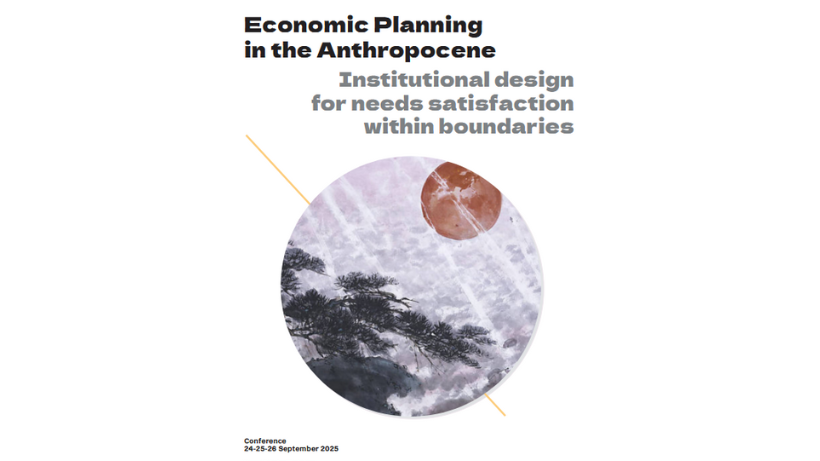
Conference: Economic Planning in the Anthropocene – Institutional design for needs satisfaction within boundaries
The description is taken from the program of the event website:
“With growing ecological concerns and mounting scientific evidence of rapid environmental degradation, governments have created multiple institutions, engaged in a vast array of policies and supported business initiatives. However, and despite some limited success in specific dimensions, the balance of five decades of activism is unambiguous: governments and businesses have failed to transform our economy in order to accommodate the ecological limits (Pestre 2020).
This failure calls for significant revisions in the way policymaking addresses the society-nature metabolism and, more specifically, the approach of institutional design regarding the economy. The return of industrial policies (Criscuolo et al. 2022) and the acknowledgment that climate action must be primarily driven by public policies (Pisani-Ferry and Mahfouz 2023) echoes a renewed interest for economic planning as a way to engage the ecological bifurcation (Durand, Hofferberth, and Schmelzer 2024; Durand and Keucheyan 2024).
This workshop ambitions to mark a milestone in that direction. It will gather leading scholars from both sides of the Atlantic and from various disciplinary backgrounds (political economy, sociology, economic history, law, accounting…) whose research could inform the design of
ecological planning institutions in the short to medium term. The core of the conference (tentative program below) will favor in-depth engagement with the various communications with a dedicated moment (assessment roundtables) to take stock of the substance of the
exchanges and clarify the complementary and tensions between contributions. Two side events will take place. On the eve of the conference a Ph-D workshop will be organized with the support of the EU MSCA-funded EPOG-DN (Economic Policies for the Global bifurcation – Doctoral Network). The last day of the conference, a forum will be organized with policymakers, including representatives from various international institutions (UNCTAD, ILO, UNDP…)”
You can sign up for the conference (for free) until September 19th here.
You can view the find the full program, including abstracts of the talks on the event’s website.
For further information, please contact: francois-xavier.hutteau-unige.ch
Program:
Wednesday September 24
14h-18h
Young scholar seminar with the participation and support of the EPOG Doctoral Network
Thursday September 25
8.45
Welcoming coffee
9.00
Introductory address – Cédric Durand (UNIGE, Switzerland)
9.15-11.00
Climate vs. Neoliberalism: causes of inaction and the call for planning – Julia Steinberger (UNIL, Switzerland)
The Great Transformation of markets: Lessons from the history of market design – Edward Nik-Khah (Roanoke College, United States of America)
11.00
Coffee break
11.15
Needs, institutions, and coalitions: how would democratic ecological planning look like? – Razmig Keucheyan (Université Paris Cité, France)
Between calculation and deliberation: Rethinking needs in planning frameworks – Silvia Rief (University of Innnsbruck, Austria)
13.00
Lunch break
14.30
The Role of Input-Output Analysis in Modeling Sustainability Transitions – Julien Lefevre (CIRED, France)
Accounting for national and corporate environmental liabilities: a steering tool towards a sustainable economy – Clément Surun (CIRED, France)
16.30
Tea break
16.45-18.00
Assessment Roundtable – Louison Cahen-Fourot (Roskilde University, Denmark) & Elena Hofferberth (UNIL, Switzerland) and speakers of the day
20.00
Dinner
Friday September 26
9.00
Welcoming coffee
9.15
State Capacity for Decarbonization: From Investable Transitions to Green Transformations – Rosie Collington (Copenhagen Business School, Denmark)
Big tech capabilities as planning devices – Cecilia Rikap (UCL Institute for Innovation and Public Purpose, United Kingdom).
11.00
Coffee break
11.15
Price Controls to Implement Green Transformation Policy – Tom Krebs (University of Manheim, Germany)
Macrofinancial conditions for a green transformative state – Daniela Gabor (University of the West of England, UK)
13.00
Lunch break
14.30
The State, the territory and the infrastructure legacy- Nelo Magalhães (EHESS, France)
When Marx Met Schumpeter: Planning and Cleantech Dominance in China – Cornel Ban (Copenhagen Business School, Denmark)
16.30
Tea break
16.45-18.15
Forum with policymakers – Edouard Morena (University of London in Paris, France)
18.45
Cocktail Dinner