
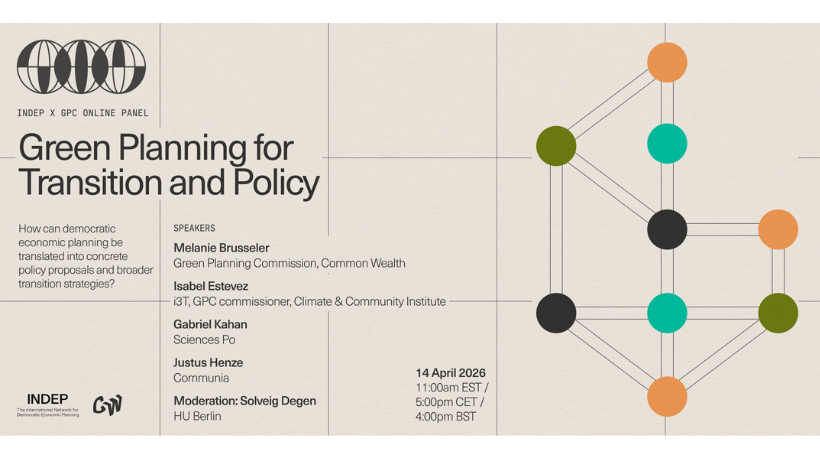
INDEP x Green Planning Commission Online Panel – Green Planning for Transition and Policy
This event will take place in English.
To participate, please register here.
INDEP and Common Wealth’s Green Planning Commission are convening a joint online panel to explore how green democratic economic planning can be translated into concrete policy proposals and integrated into broader transition strategies.
Melanie Brusseler will introduce the Green Planning Commission (GPC), outlining its mandate, research agenda and forthcoming areas of work. The GPC brings together researchers and practitioners to examine how democratic planning institutions can guide decarbonization, industrial strategy, public investment, and the restructuring of key sectors in ways that are socially just and ecologically grounded. Following the introduction, the panelists will offer their perspectives on how democratic economic planning can be utilized for transitions regarding their national contexts and respective areas of expertise.
Our Panelists:
Melanie Brusseler – Green Planning Commission, Common Wealth
Isabel Estevez – i3T, GPC commissioner, Climate & Community Institute
Gabriel Kahan – Sciences Po, University of Wisconsin-Madison
Justus Henze – Communia
Solveig Degen (Moderation) – Humboldt-University Berlin
Melanie Brusseler is a political economist and the US Programme Director at Common Wealth. She is also a co-founder of the Green Planning Commission. Her research focuses on green democratic planning and green macrofinance, and she has published widely on these topics. Her writing on economic planning has appeared, among others, in the Financial Times, Jacobin, Phenomenal World, and The Guardian.
Isabel Estevez is an institutional and development economist whose work focuses on the dynamics of economic transformation, nature–economy relations, and green transitions. She is the former Deputy Director of Industrial Policy and Trade at the Roosevelt Institute’s Climate and Economic Transformation Program. She has advised policymakers in the United States, Europe, and Latin America, as well as multilateral institutions and civil society organisations, on the design of transformative industrial policies. She has published widely on green industrial strategy, including the working paper “Global Green Industrial Policy,” co-authored with Thea Riofrancos for Climate & Community.
Gabriel Kahan is a PhD candidate at the University of Wisconsin–Madison and a visiting researcher at the Centre de Sociologie des Organisations (CSO) at Sciences Po. His research lies at the intersection of political sociology, development, and finance. He studies the effects of green industrial policy on multinational emitters, the role of derisking in energy transitions, and compares France’s postwar experience with industrial planning to contemporary experiments in “ecological planning” under the country’s National Low-Carbon Strategy.
Justus Henze is a political economist and PM project coordinator at the Communia think tank in Germany, where he works on strategies for the socialisation of the German energy sector. He is also speaker of the Expropriate Deutsche Wohnen campaign and a co-founder of the German Network for Democratic Economic Planning. His writing on green economic planning has appeared in Surplus Magazine, Jacobin, and Neues Deutschland.
Solveig Degen is a doctoral candidate in the research project Socialization in Theory and Practice, which is based at the Centre for Social Critique in Berlin. Solveig leads the subproject on socialization in the energy sector, which is also the topic of her dissertation. As part of her doctoral studies, she is conducting a systematic analysis of the problems of market-based energy provision and investigating the possibilities and challenges of socializing energy systems in the EU context. In her research, she combines approaches from political economy and sociology with perspectives from political theory and critical social philosophy. Previously, she worked at the Institute for Spatial and Social-Ecological Transformations (ISSET) at the Vienna University of Economics and Business, where she also completed her Master’s degree in Social-Ecological Economics and Policy.