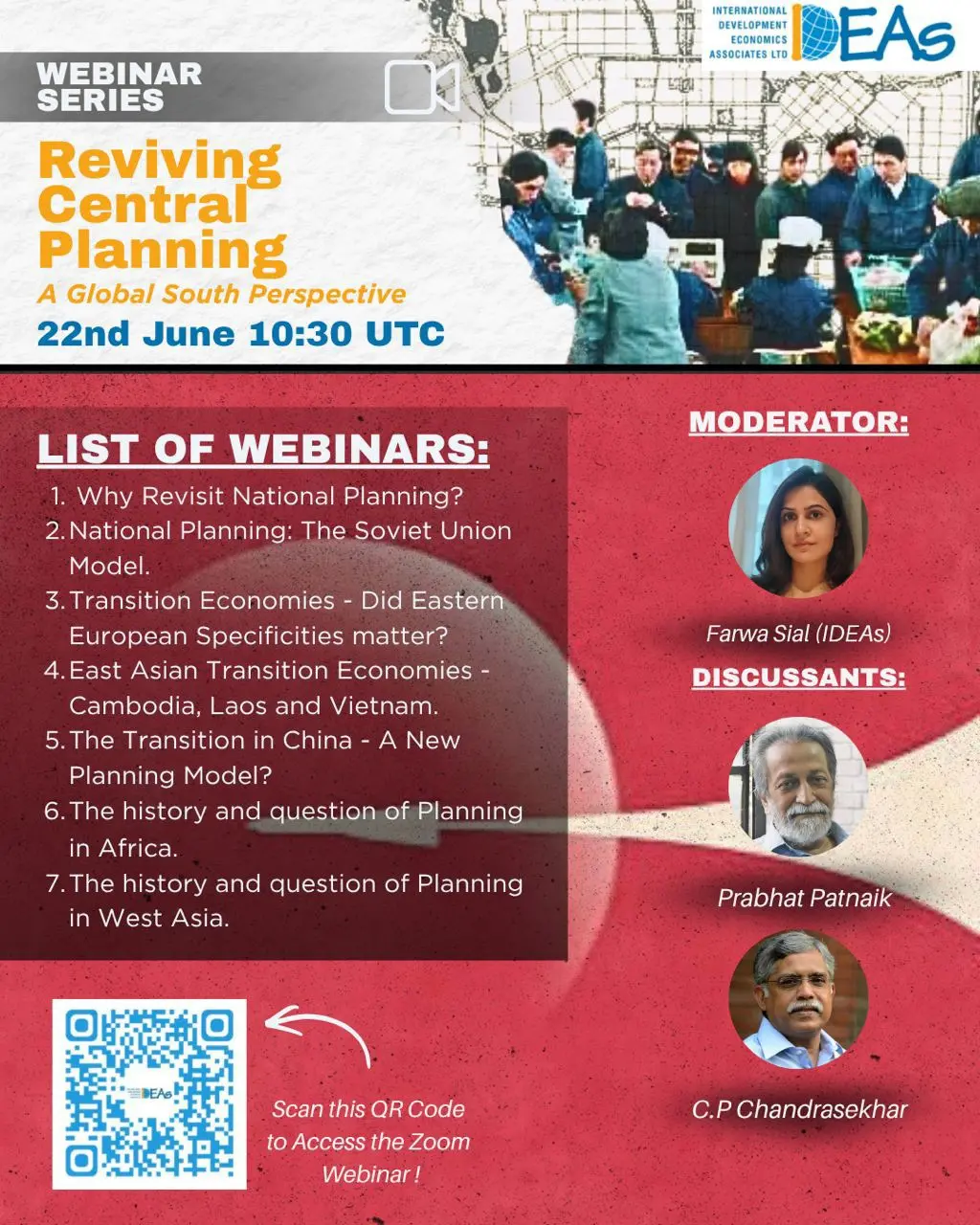
The first webinar of the “Reviving Central Planning – A Global South Perspective” series, hosted by the International Development Economics Associates Limited (IDEAs), has been uploaded to their YouTube channel. It is titled “Why revisit national planning?” and featured C. P. Chandrasekhar and Prabhat Patnaik as panelists and was moderated by Farwa Sial. You can watch the video below:
The webinar series will feature 6 more sessions, a list of which is below:
- Why revisit national planning? (Schedule: 22 June, 10:30 UTC)
- National planning: The Soviet Union model
- Transition economies: Did Eastern European specificities matter?
- East Asian transition economies: Cambodia, Laos, and Vietnam
- The transition in China: A new planning model?
- The history and question of planning in Africa
- The history and question of planning in West Asia
You can register for them here. The dates for the upcoming sessions haven’t been announced yet, but as soon as they are we will post them in our events section.
Here is the description of the webinar series:
“The collapse of the Soviet Union was one of the seismic shifts of the 20th century. It created a crisis for state-led development models. The most direct impacts were on the 15 former Soviet republics and the Eastern Bloc countries of the Warsaw Pact. But many developing countries, particularly in Africa and Asia, which had adopted elements of central planning and state-led development, often influenced by Soviet ideology or simply seeing it as a tool for rapid industrialisation, also encountered a setback. In what followed, countries actively sought integration with the developed market economies by adopting policies recommended by Western economic institutions, like the International Monetary Fund, the World Bank, and later the World Trade Organisation. In doing so, they adopted market-oriented principles and ultimately abandoned central planning in different ways. Some embarked on a wholesale and difficult transition towards market economies (often called ‘shock therapy’), while others transformed their specific models of socialism into varied models of ‘market socialism’.
However, integration with the world capitalist market came with a heavy cost for the majority of countries as the impact of neoliberalism and its current decline prove. This webinar series aims to explore the basics of central planning as they existed around the world and understand the relevance of planned development today. The discussions will focus on the diverse cases of Russia, Eastern Europe, and East Asia to provide a historical analysis of their respective planning models, an assessment of the strengths and limitations of their implementation of these models, as well as an introduction to the rich analysis that emerged from the economic debates and ideas of economists on the idea of and the actual experience with planning.”