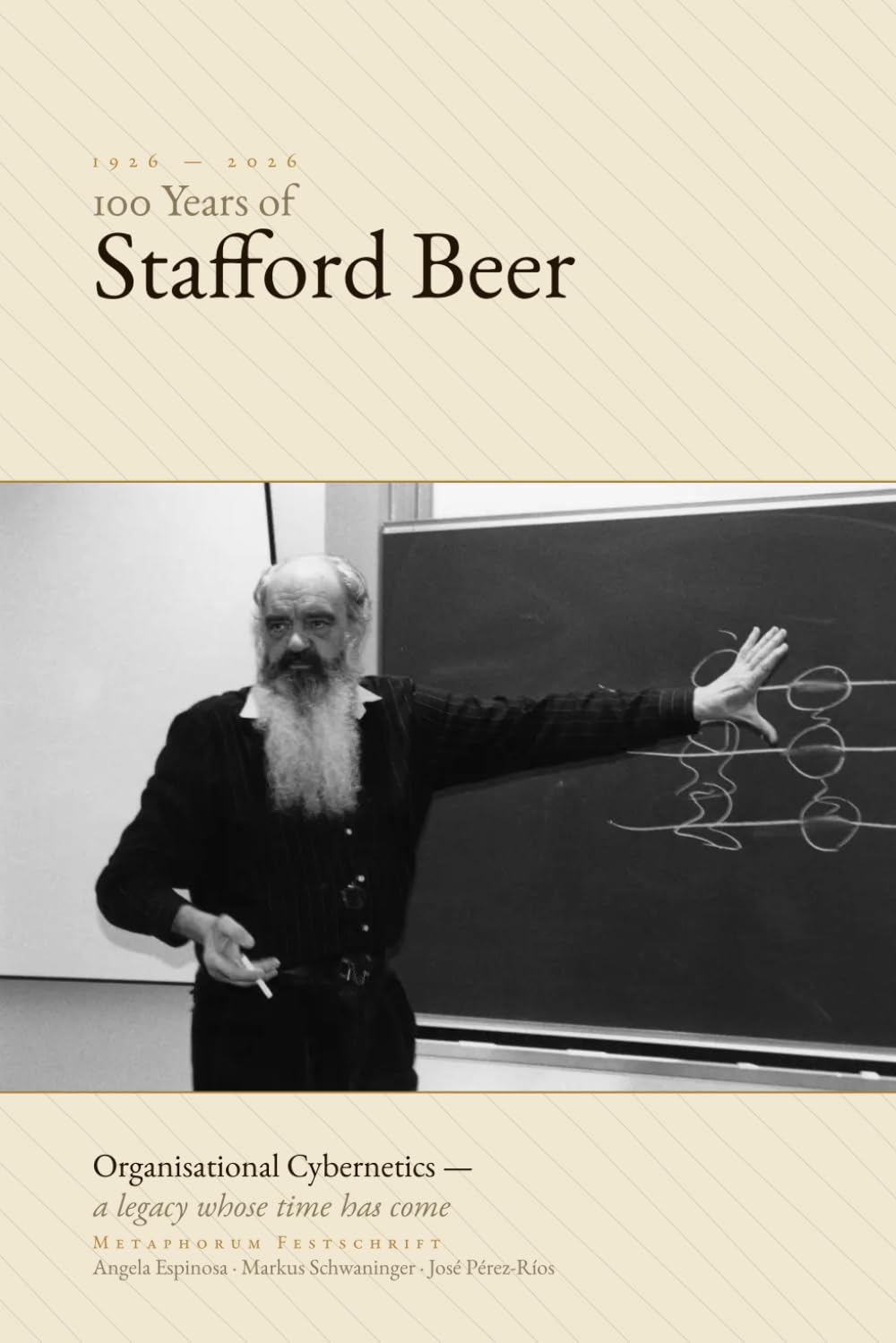
The Metaphorum Community has published the book 100 Years of Stafford
Beer Organisational Cybernetics: a legacy whose time has come that’s edited by Dr Angela Espinosa, Dr Markus Schwaninger, and Dr José Pérez-Ríos. The book is a collection of essays, reflections, and tributes from scholars, practitioners, and friends who gathered to celebrate the centenary of Stafford Beer — pioneer of management cybernetics, architect of the Viable System Model, and originator of Team Syntegrity.
A summary of the book can be found below:
In Memoriam of Stafford Beer, who will be 100 years old in 2026, the Metaphorum community has undertaken the development of this Festschrift, to celebrate his life and legacy. Stafford pioneered Organisational Cybernetics, namely its main theories and methods, the Viable System Model (VSM) and Team Syntegrity (TS) more than 50 years ago. Even so, the relevance of his work has only begun to be recognised widely in the last few decades, after he passed away. His VSM contains the strongest organization theory and methodology currently available to our knowledge.
One of the main obstacles for dissemination of his work, has been the accessibility of the original books to wider audiences, – practitioners and researchers alike. Even nowadays, accessing the original books is difficult both in terms of availability and costs.
After Beer‘s famous Cybersyn project in Chile (that could not be fully implemented), where he fully applied the principles of the VSM at the national level, many of his pupils, collaborators and associated researchers have continued developing his theory by applying the VSM and TS in a variety of organisational contexts in countries around the world.
In this book, which is designed to be an online, open access, creative commons book, we aim to invite leaders in organisational cybernetics to provide an overview of the way Stafford’s original ideas have continued to evolve in the last 25 years, the way they have influenced other fields of knowledge, and the way their applicability has been tested in different contexts, places and cultures.
We aim also to provide a clear, readable and accessible landscape of past and new directions for development of Stafford’s theories and pertinent tools. Our intention is to leave an alive testimony of a co-evolving cyber-systemic community of theory and practice and provide access to freely available contents.
You can download the book for free in either PDF or EPUB format here or purchase a paperback copy here.