On Thursday 19th March from 9:30AM-3PM UTC+1 , the workshop Planification Écologique: Reality and Aspiration, organized by Gabriel Kahan (Sciences Po) and supported by LIEPP’s Environmental Policies research group (project Ecological Planning in the 21st Century: Uses, Forms, Methods and Effects) and INDEP, was held at SciencesPo Salle 900 9 rue de la Chaise Paris.
The papers that were present at the workshop have now been uploaded online.
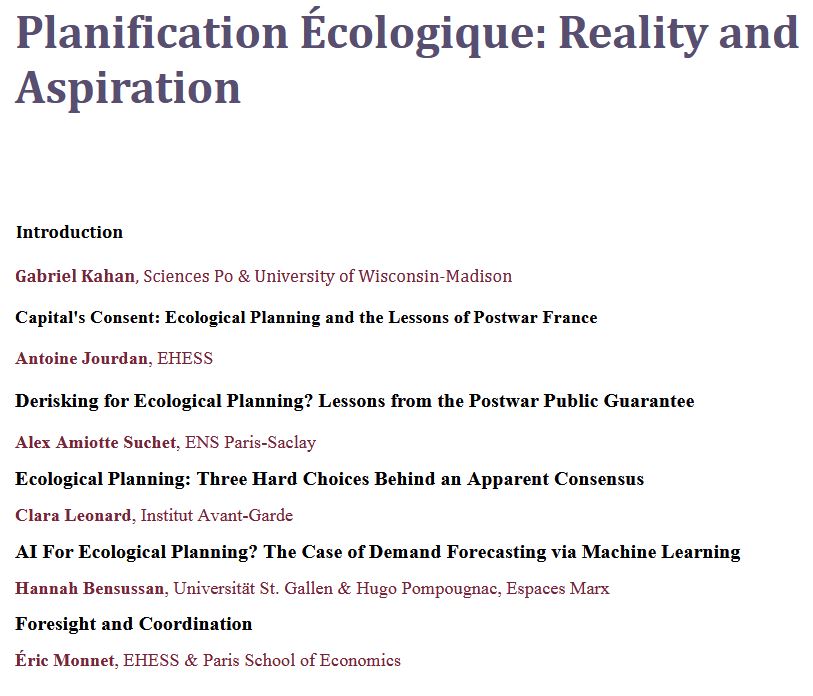
A summary of the papers can be found below:
Ecological planning in France remains ill-defined. Conceptually, it often serves as a canvas upon which we project different meanings — at times evoking a nostalgia for an earlier period, in other moments a vague placeholder for progressive politics. As Mathilde Viennot has written, “La planification écologique reste donc à inventer. It hints at a new political project, but without clear definition or parameters. With the support of LIEPP as well as the International Network for Democratic Economic Planning, I convened a workshop on March 19th, 2026 to illuminate this still-fuzzy concept. The proceedings were both descriptive and normative, with the aim of foregrounding concrete institutional contexts where we might locate and evaluate ecological planning. The following debate compiles the interventions made by these participants in an abridged form. They mirror the two core themes of the event. First, we turn to scholars of France’s previous planning experience. Namely, postwar France and its dirigiste approach to industrial development has been the subject of a broad and wide-ranging literature. In the context of today’s debates on ecological transitions, it is increasingly held up as a model by social scientists.
You can read the papers here.