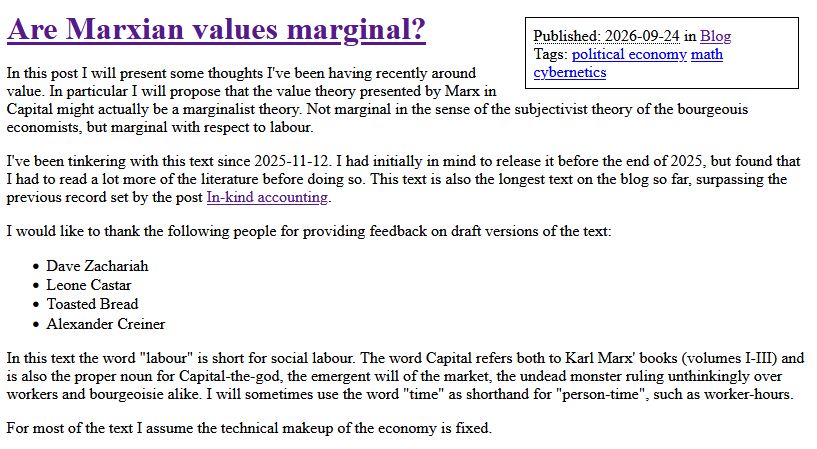
On his website, Tomas Härdin has published a blog post that outlines his current understanding of Karl Marx’s labour theory of value and its implications for future attempts at socialist planning.
A summary of the article can be found below:
In this post I will present some thoughts I’ve been having recently around value. In particular I will propose that the value theory presented by Marx in Capital might actually be a marginalist theory. Not marginal in the sense of the subjectivist theory of the bourgeouis economists, but marginal with respect to labour.
I’ve been tinkering with this text since 2025-11-12. I had initially in mind to release it before the end of 2025, but found that I had to read a lot more of the literature before doing so. This text is also the longest text on the blog so far, surpassing the previous record set by the post In-kind accounting.
I would like to thank the following people for providing feedback on draft versions of the text:
- Dave Zachariah
- Leone Castar
- Toasted Bread
- Alexander Creiner
In this text the word “labour” is short for social labour. The word Capital refers both to Karl Marx’ books (volumes I-III) and is also the proper noun for Capital-the-god, the emergent will of the market, the undead monster ruling unthinkingly over workers and bourgeoisie alike. I will sometimes use the word “time” as shorthand for “person-time”, such as worker-hours.For most of the text I assume the technical makeup of the economy is fixed.
You can read the article here.